A rainwater tank is one of the most practical upgrades an Australian homeowner can make. It cuts your mains water use, keeps the garden alive through restrictions, and in many areas pays for itself within a few years through lower water bills. But walk into any tank supplier and you face a bewildering wall of options: 1,000 litres or 10,000? Slimline or round? Pump or gravity feed? Buy too small and the tank sits empty all summer; buy too big and you have paid for capacity you will never fill.
This guide shows you how to size a tank properly for garden use, using your roof area and your local rainfall — the two numbers that actually determine how much water you can harvest. We also cover tank shapes, pumps versus gravity feed, first-flush diverters, council rebates and the maintenance that keeps your water clean.
How Much Water Can Your Roof Collect?
The maths is simple. One millimetre of rain falling on one square metre of roof yields one litre of water. So the formula is:
Roof catchment area (square metres) x annual rainfall (millimetres) x 0.85 = litres collectable per year. (The 0.85 factor accounts for losses — evaporation, splashing, gutter overflow and the first-flush diverter.)
Work through an example. A typical suburban home might have 120 square metres of roof connected to the tank. In Sydney, with roughly 1,200 millimetres of annual rain, that roof can harvest about 120 x 1,200 x 0.85 = 122,400 litres a year. In Perth, with around 730 millimetres falling almost entirely in winter, the same roof yields about 74,500 litres — but nearly all of it arrives between May and September, which changes the sizing logic completely.
Measure your roof catchment honestly: only count the roof area whose downpipes actually feed the tank, not the whole house. A tank connected to a single downpipe might only harvest from 30 to 50 square metres of roof, which caps your collection no matter how big the tank is.
Sizing by Rainfall Zone
Australia's rainfall patterns matter more than the annual total. Tanks in different zones play different roles:
Summer-rainfall zones (Brisbane, Darwin, northern New South Wales)
Rain arrives when the garden is thirstiest, which is ideal: the tank refills regularly through the watering season. A moderate tank of 2,000 to 5,000 litres connected to a decent roof area will cycle — fill and empty — many times a year, so you get excellent value per litre of capacity. Oversizing here wastes money because the tank rarely needs huge reserves.
Winter-rainfall zones (Perth, Adelaide, Melbourne)
Almost all rain falls when the garden needs the least water, so the tank's job is to store winter rain for summer use. That demands bigger storage: 5,000 to 10,000 litres or more for a serious garden, because the tank must bridge a five-month dry summer. Check your roof maths carefully here — a small roof cannot fill a big tank over one winter, and an empty 10,000-litre tank is just an expensive sculpture.
Even-rainfall and arid zones (Sydney, Hobart, inland)
Sydney's fairly even rainfall suits mid-size tanks of 3,000 to 5,000 litres that top up year-round. In arid inland areas with low, erratic rainfall, maximise roof catchment first — every square metre counts — and size the tank to capture rare big falls, typically 5,000 litres plus.
Slimline vs Round Tanks
Tank shape is mostly about fitting your block, not performance:
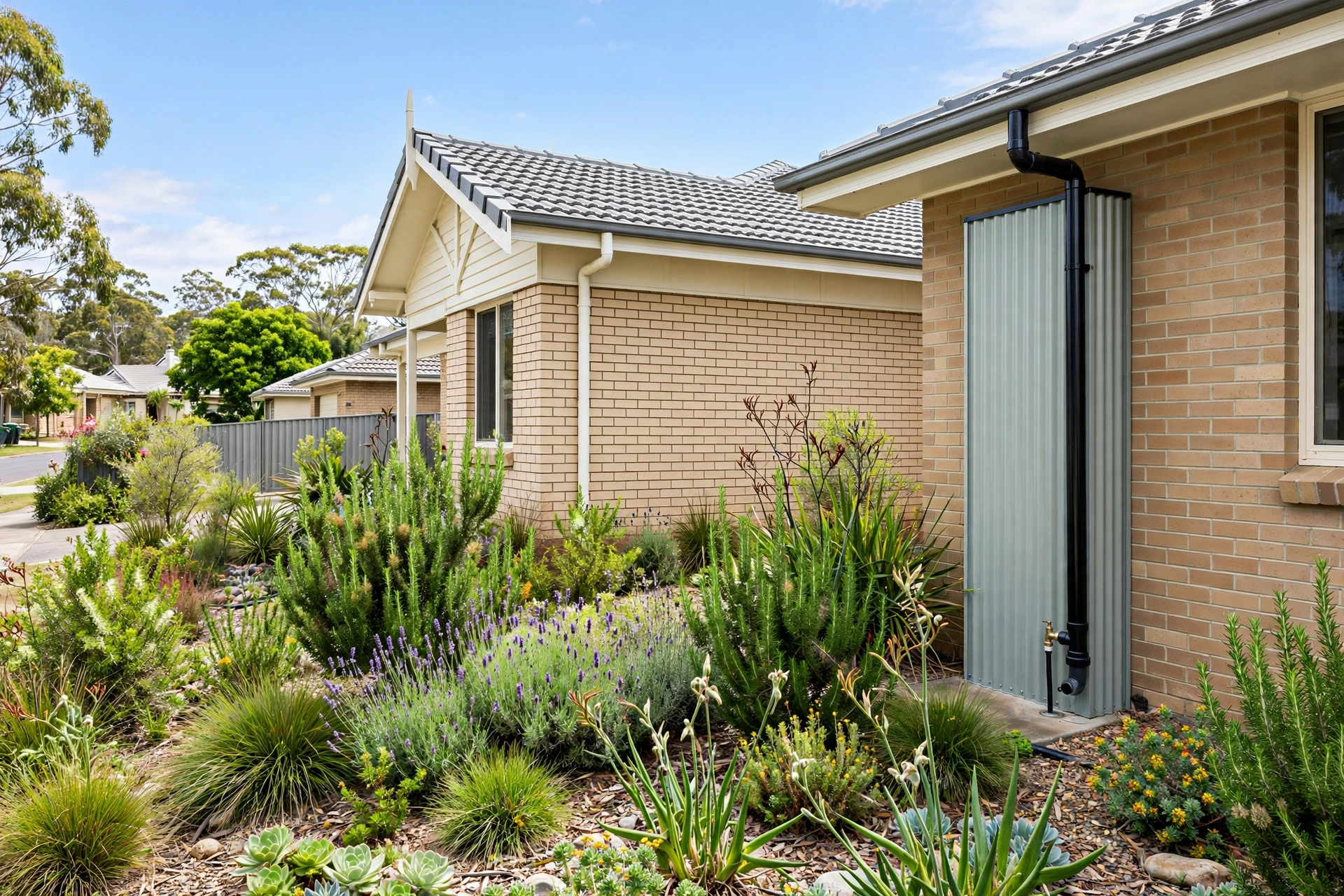
- Slimline tanks sit flat against a wall or fence and suit narrow side passages common on modern small blocks. They cost more per litre than round tanks and offer fewer size options, but they fit where nothing else will.
- Round tanks (poly or steel) give you the most litres per dollar and the widest size range, from 1,000 litres up to 25,000 plus. They need a clear circular footprint, so measure your space carefully.
- Underground tanks and bladders hide under driveways or decks where space is tight above ground, but they cost significantly more to install and need a pump by definition.
Polyethylene tanks dominate the domestic market: they are light, rust-proof, available in colours to match the house, and carry long warranties. Steel tanks (corrugated or Colorbond-style) suit rural properties and larger sizes. Whichever you choose, the tank must sit on a flat, stable, properly prepared base — a compacted crusher-dust pad or concrete slab — because a full 5,000-litre tank weighs five tonnes.
Pump vs Gravity Feed
How the water gets from the tank to the garden decides how useful the tank is:
- Gravity feed works if the tank outlet sits higher than the garden — for example, a tank on a stand feeding beds downhill. It is free to run and utterly reliable, but pressure is low: fine for a soaker hose, hopeless for sprinklers.
- Pump feed is the standard for suburban tanks. A small automatic pressure pump gives proper hose and sprinkler pressure and can run drip irrigation zones. Mains-switching pumps can even plumb tank water to toilets and laundry, automatically switching to mains when the tank runs dry.
If you are only hand-watering a few beds, gravity may suffice. For any serious garden irrigation, budget for a pump — and put it on a timer or pressure switch so it is not running dry and burning out.
First-Flush Diverters and Keeping Water Clean
The first rain after a dry spell washes dust, bird droppings, leaves and possum presents off your roof. A first-flush diverter — a simple chamber on the downpipe that captures the first 20 to 50 litres and diverts it away from the tank — keeps the worst of it out of your water. It is cheap, and for garden use it is the difference between clean tank water and a smelly soup.
Also fit leaf-eater gutter guards or a simple mesh screen where the downpipe meets the tank, and make sure the tank is fully sealed with a mozzie-proof mesh over every opening. Mosquitoes breeding in tanks are both a nuisance and, in some states, a regulatory issue.
Council Approvals and Rebates
Rules vary enormously across Australia, so check before you buy:
- Most councils allow tanks up to a certain size without approval; larger tanks or tanks in heritage areas may need a development application.
- Some states and councils offer rebates for tanks plumbed to toilets, laundry or hot water systems — garden-only tanks sometimes qualify, sometimes do not.
- New homes in several states must meet water-efficiency standards (such as BASIX in New South Wales), which often effectively require a tank.
- Plumbing tank water into the house (toilets, laundry) legally requires a licensed plumber and a backflow prevention device to protect the mains supply.
A quick call to your local council's duty planner clarifies approvals, and your state water authority's website lists current rebates. Rebates come and go with drought cycles, so check the current status rather than relying on old advice.
Tank Maintenance
A neglected tank becomes a liability. Twice a year, in autumn and spring:
- Clean gutters and first-flush diverters so debris does not wash into the tank.
- Check inlet screens and mozzie mesh for damage.
- Look inside the tank with a torch: a thin layer of sediment is normal, but a thick sludge layer means it is time for a professional clean.
- Run the pump briefly to confirm it primes and pressurises properly.
- Trim overhanging branches that drop excessive leaves into gutters.
Desludging every few years keeps water fresh and protects pumps. If the water smells or looks discoloured, do not use it on edible plants until you have identified and fixed the cause — usually decaying organic matter or a dead animal in the gutter.
Size the tank to your roof and rainfall, not to your ambitions. A 3,000-litre tank that fills and empties six times a year delivers 18,000 litres; a 10,000-litre tank on a small roof that never fills delivers far less. Turnover beats capacity.
Frequently Asked Questions
What size rainwater tank do I need for a garden?
For an average suburban garden in a summer-rainfall area, 2,000 to 5,000 litres connected to at least 50 square metres of roof works well. In winter-rainfall cities like Perth and Adelaide, aim for 5,000 to 10,000 litres to carry winter rain into summer. Always run the roof-area maths first — the roof, not the garden, sets the upper limit.
Can I drink rainwater from my tank?
Many rural Australians do, but it requires proper setup: first-flush diversion, fine filtration and usually UV treatment, plus regular testing. This guide covers garden use, where standards are lower. If you want potable water, talk to a specialist supplier and check your state health department's guidelines.
Do I need council approval for a rainwater tank?
Often no for modest above-ground tanks, but it depends on your council, the tank size and your property's zoning or heritage status. Tanks plumbed into household plumbing always need a licensed plumber. Check with your local council before ordering — a five-minute phone call avoids expensive surprises.
How long do poly rainwater tanks last?
Quality polyethylene tanks typically carry 10 to 20 year warranties and often last well beyond that if sited out of extreme stress — on a proper base, not in contact with abrasive surfaces, and with fittings not over-tightened. UV stabilisers in modern tanks handle Australian sun far better than early generations did.
Will a tank save me money?
For garden use, a sensibly sized tank usually pays for itself over several years through reduced mains water bills, with faster payback in cities with high water prices and in drought years when restrictions would otherwise force you to let the garden die. The lifestyle value — a green garden through a dry summer — is harder to put a dollar figure on but very real.