
The great Australian backyard is shrinking. As blocks get smaller and townhouses multiply, the dream of a sprawling outdoor entertaining area has given way to a smarter challenge: how to fit a genuinely functional outdoor kitchen into a compact courtyard, narrow side passage or petite patio. The good news is that small spaces force good design — and a well-planned compact outdoor kitchen can outperform a sprawling one for sheer usability.
An outdoor kitchen does not need to mean a $30,000 built-in showpiece. At its heart, it is simply a weatherproof place to cook, prepare and serve food outdoors. With clever zoning, the right materials and realistic budgeting, even a 3 x 3 metre corner can become the hardest-working part of your home. Here is how to plan it.
Start With Zones, Not Appliances
Before buying anything, map your space into three compact zones — the same logic professional kitchen designers use, shrunk to fit:
- Hot zone: the BBQ, grill or pizza oven. This needs the most clearance and the best ventilation.
- Prep zone: benchtop space beside the hot zone for chopping, plating and serving. Aim for at least 60–90 cm of clear bench.
- Storage and clean-up zone: weatherproof cupboards for utensils and a small sink or at least a nearby tap.
Arrange these in an L-shape or a straight run along one wall or fence. The golden rule for small spaces: keep the work triangle tight. Every step you save between BBQ, bench and storage is multiplied hundreds of times over a summer of entertaining.
Compact BBQ Stations
The BBQ is the centrepiece, and for small yards the choice matters. A 4-burner freestanding BBQ on wheels offers flexibility — roll it out for a party, tuck it against the wall afterwards. Hooded BBQs effectively give you an outdoor oven for roasts, which multiplies what the station can do.
For the ultimate space-saver, consider a built-in BBQ dropped into a custom benchtop run. It costs more but reclaims the BBQ's footprint as usable bench space around it, and looks a hundred times tidier. Kettle-style charcoal BBQs and compact pizza ovens are excellent secondary cookers that store in a corner. Whatever you choose, allow at least 1–1.2 metres of clear space in front for the cook to work safely.
Benchtops and Storage That Survive the Weather
Australian conditions are brutal on outdoor cabinetry: blazing UV, driving rain, and humidity that swells cheap particleboard in a single season. Choose materials honestly rated for outdoors: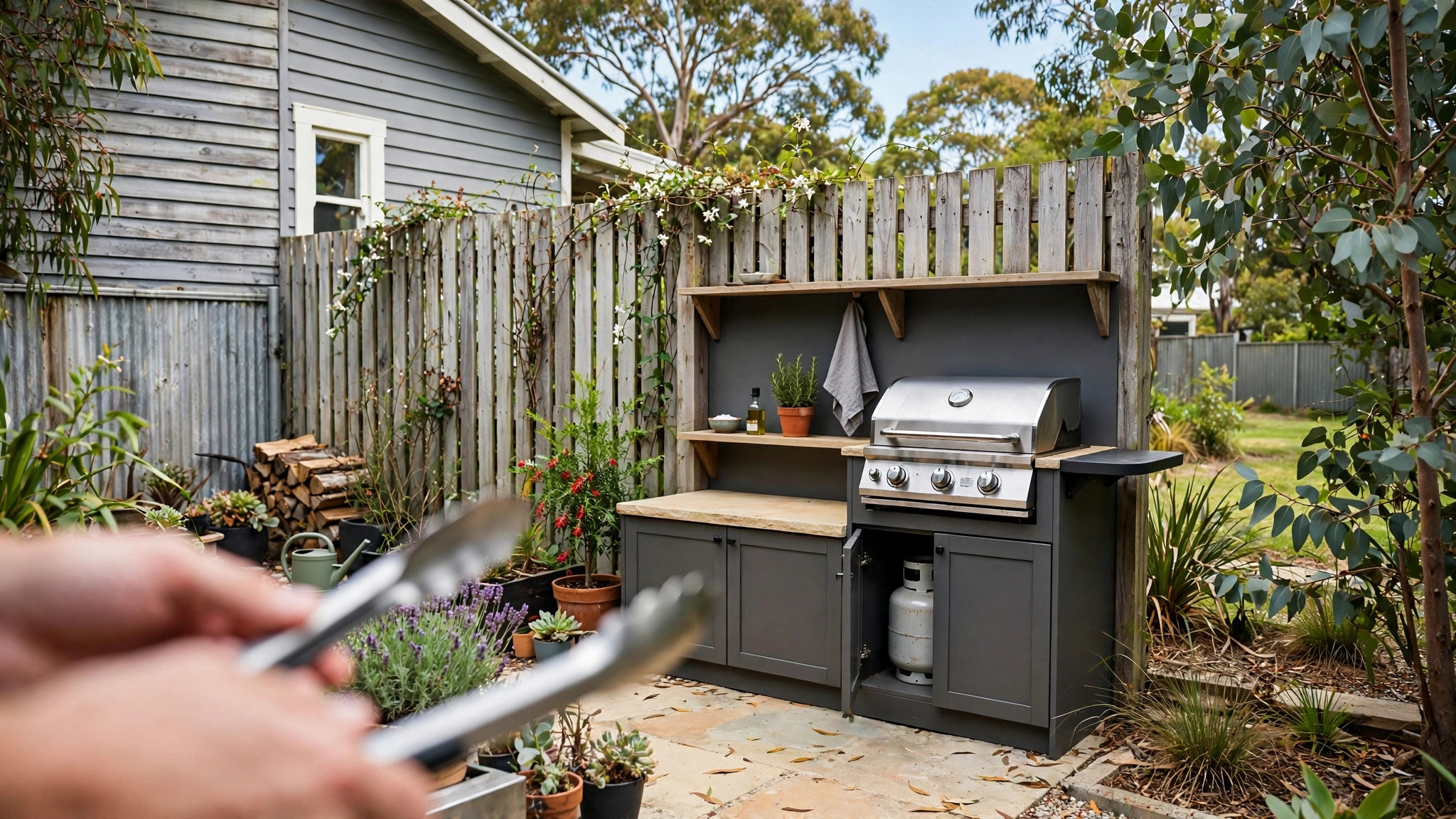
- Benchtops: sealed concrete, granite, stainless steel or exterior-grade compact laminate. Timber looks beautiful but needs regular oiling — fine if you enjoy the maintenance, punishing if you do not.
- Cabinetry: marine-grade plywood with exterior sealant, powder-coated aluminium, or stainless steel. Standard kitchen flat-pack cabinetry will fail outdoors — do not be tempted by the price.
- Storage: deep drawers beat cupboards for accessing utensils. Include a sealed bin for dry goods and a ventilated spot for the gas bottle, which must by law be stored upright, outdoors, and away from ignition sources.
A simple, durable approach for tight budgets: a stainless-steel workbench or two (the kind sold for commercial kitchens) gives you a hygienic, indestructible prep surface for a few hundred dollars, and it will outlast almost anything else.
Shade and Cover Options
An outdoor kitchen without shade is unusable through an Australian summer. Options scale with budget:
- Shade sails: $200–$800 installed, excellent coverage, but check they are positioned so rain runoff does not pour onto the cooking zone.
- Retractable awnings: $1,500–$4,000, adjustable for sun angle, and they retract in storms.
- Pergola with polycarbonate or insulated roofing: $3,000–$10,000+, the premium permanent solution that also defines the "room."
Whichever you choose, remember ventilation: a BBQ under a low solid roof needs generous open sides so heat and smoke escape. Never enclose a gas BBQ in a way that traps fumes.
Power, Plumbing and Gas: The Unsexy Essentials
This is where small outdoor kitchens succeed or fail, and where professional help is non-negotiable.
- Power: at least one weatherproof double power point for the BBQ ignition, lighting and a bar fridge. Have a licensed electrician install outdoor-rated fittings on their own circuit — this is not a DIY job in Australia.
- Plumbing: a sink is the single biggest upgrade to an outdoor kitchen's usefulness, but it needs water supply and drainage. A simple cold-water tap and a sink draining to stormwater (check council rules — greywater regulations vary) is the minimum. Hot water requires a plumber and adds cost.
- Gas: natural gas plumbed to the BBQ point is the gold standard — no bottle swaps mid-party. It requires a licensed gasfitter. Otherwise, keep a spare 9 kg bottle so you never run out during a cook-up.
- Lighting: task lighting over the BBQ and bench (warm LED strip or spotlights) plus ambient festoon lights for atmosphere. Solar options work for ambience; wired lighting is better for task areas.
Check with your local council whether any part of the build needs approval — permanent roofed structures and plumbing work often do.
Flooring for the Kitchen Zone
Define the kitchen as a "room" with its flooring: pavers, concrete, outdoor tiles or composite decking all work. Whatever you choose, prioritise a non-slip surface (grease and water are inevitable), easy cleaning, and heat resistance near the BBQ. A slightly darker paver hides cooking stains gracefully.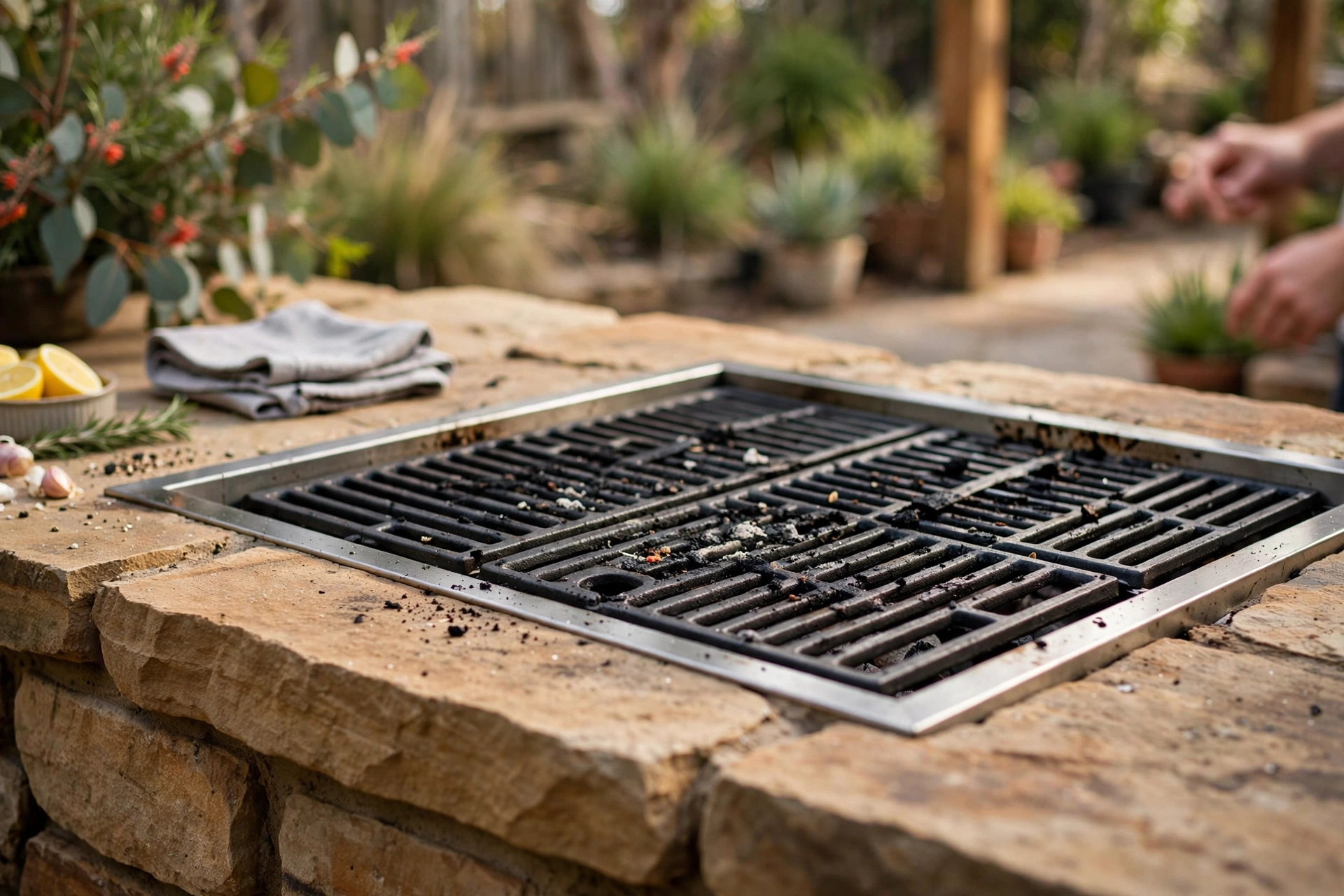
Budget Breakdowns: Three Tiers
The Clever Basic: $1,500–$4,000
Quality freestanding hooded BBQ ($600–$1,500), stainless workbench for prep ($300–$600), shade sail ($200–$800), outdoor-rated power point by an electrician ($300–$600), festoon lights and storage tubs. Enormously functional for the money.
The Solid Mid-Range: $5,000–$12,000
Built-in BBQ in a custom benchtop run, marine-ply or aluminium cabinetry, sealed concrete or stone benchtop, sink with cold tap, retractable awning or pergola cover, proper task lighting and a bar fridge. This is the sweet spot for most families.
The Entertainer: $15,000–$30,000+
Premium built-in BBQ plus pizza oven or smoker, stone benchtops, full cabinetry, plumbed natural gas, hot and cold water, insulated patio roof with ceiling fan, integrated lighting and sound. A genuine outdoor room.
Small-Space Tricks That Punch Above Their Weight
- Go vertical: wall-mounted herb planters, hanging utensil rails and fold-down benches reclaim floor space.
- Fold and roll: drop-leaf benches and BBQs on castors let the space transform between everyday use and party mode.
- Mirror the indoors: position the outdoor kitchen adjacent to the indoor kitchen with a servery window or wide sliding doors — food travels metres, not tens of metres.
- One colour palette: matching the outdoor finishes to your interior makes a small courtyard feel like a continuation of the house, not an afterthought.
- Grow the garnish: a narrow planter of herbs beside the prep bench means every meal starts with a snip — and it softens hard surfaces beautifully.
The best outdoor kitchen is not the biggest or the most expensive — it is the one positioned so well and planned so tightly that cooking outside becomes easier than cooking inside.
Frequently Asked Questions
How much does a small outdoor kitchen cost in Australia?
A functional basic setup runs $1,500–$4,000, a solid mid-range build $5,000–$12,000, and a premium entertainer's kitchen $15,000–$30,000+. The biggest cost drivers are roofing, plumbing and custom cabinetry.
Do I need council approval for an outdoor kitchen?
Freestanding BBQs and furniture generally do not need approval, but permanent roofed structures, plumbing work and gas connections often do. Rules vary by council, so check before building anything fixed.
Can I install outdoor power points myself?
No. All fixed electrical work in Australia must be done by a licensed electrician. Outdoor installations need weatherproof fittings and usually their own circuit protection.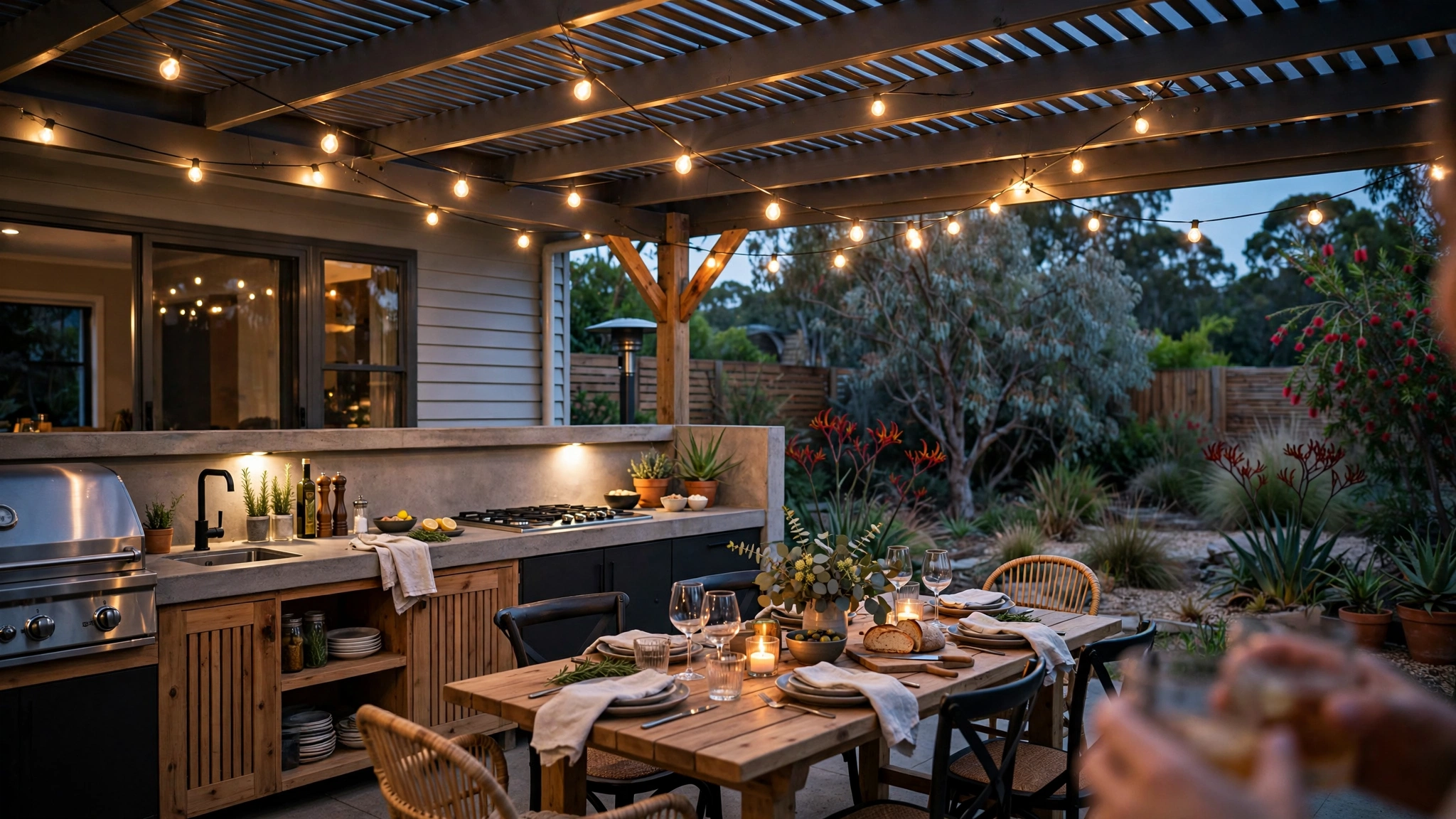
What is the best benchtop for an outdoor kitchen?
Sealed concrete, granite and stainless steel are the most durable low-maintenance choices. Exterior-grade compact laminate is lighter and cheaper. Avoid standard indoor benchtop materials — they will fail within a season or two.
How do I keep an outdoor kitchen usable in summer?
Shade is essential — a sail, awning or pergola roof. Position for afternoon shade where possible, ensure good ventilation around the BBQ, and choose light-coloured surfaces that do not radiate heat.

